

Introduction
Choosing the right cleaning equipment is essential for maintaining efficient housekeeping operations in commercial and institutional facilities. Offices, hotels, hospitals, schools, factories, shopping centres, warehouses, restaurants, and residential complexes all have different cleaning requirements. A wringer trolley can make routine floor cleaning more convenient by combining water storage, mop wringing, and mobility in one unit.
However, selecting a wringer trolley should not be based only on appearance or price. Capacity is one of the most important factors to consider, as it determines how much water can be carried during a cleaning route. A trolley that is too small may require frequent refilling, while an unnecessarily large trolley can become difficult to move when filled.
The right size depends on several factors, including the size of the cleaning area, frequency of cleaning, distance from water sources, available storage space, and the number of employees using the equipment.
For businesses looking for dependable commercial cleaning equipment, selecting an experienced Wringer Trolley Manufacturer is equally important. Sangam Plastic Industries Private Limited manufactures plastic cleaning and waste management products for commercial and institutional applications, focusing on practical design, suitable materials, durability, and consistent manufacturing.
Why Wringer Trolley Capacity Matters
Capacity directly affects the efficiency of a cleaning operation. If cleaning staff need to cover a large floor area, having adequate water capacity can reduce unnecessary trips to a refill point. This can be especially useful in factories, warehouses, hotels, hospitals, shopping centres, and other large facilities.
At the same time, more capacity does not always mean better performance. When a trolley is filled with water, its overall weight increases. A very large trolley may therefore require more effort to push and may be difficult to manoeuvre through narrow corridors, doorways, elevators, or crowded areas.
The goal should be to choose a capacity that provides sufficient cleaning coverage while remaining comfortable and practical for employees to handle.
What Should You Consider Before Choosing a Capacity?
Before purchasing a wringer trolley, facility managers should look at the complete cleaning process rather than focusing only on the bucket size.
Size of the Cleaning Area
A small office with a short cleaning route may not need a high-capacity trolley. A large hotel, warehouse, hospital, or shopping centre may require more water capacity because cleaning staff have to cover significantly larger areas.
However, floor area alone should not determine the decision. The building layout and distance between cleaning zones are also important.
Distance to Water Sources
The location of water sources can have a major impact on the ideal trolley capacity. If employees can refill their trolley easily, a smaller model may be sufficient.
If the water source is far away, a larger-capacity trolley can reduce the number of refill trips and make the cleaning route more efficient.
Cleaning Frequency
Facilities with frequent cleaning requirements may benefit from an appropriate trolley capacity. High-traffic environments such as hospitals, restaurants, shopping centres, and hotels may require cleaning several times a day.
A suitable trolley can help cleaning teams carry enough water for their assigned route without repeatedly interrupting their work.
Storage Space
The trolley should also fit comfortably into the designated housekeeping or equipment storage area. Larger-capacity models may require more storage space, so businesses should check dimensions before making a purchase.
Small, Medium, or Large Capacity?
Different facilities can benefit from different trolley sizes.
Small-capacity trolleys are generally suitable for compact spaces such as small offices, clinics, retail stores, restaurants, and residential buildings. Their smaller size can make them easier to manoeuvre around furniture, narrow corridors, and restricted areas.
Medium-capacity trolleys provide a practical balance between water carrying capacity and mobility. They can be suitable for offices, hotels, schools, commercial buildings, healthcare facilities, and other medium-sized properties.
Large-capacity trolleys can be useful for factories, warehouses, shopping centres, large hotels, campuses, and other facilities where cleaning staff cover extensive floor areas. They can reduce the need for frequent refilling, particularly when water sources are located far away.
The most suitable option depends on the facility’s actual cleaning route rather than simply choosing the largest available model.
Single Bucket vs Double Bucket Trolleys
Capacity is also influenced by trolley configuration.
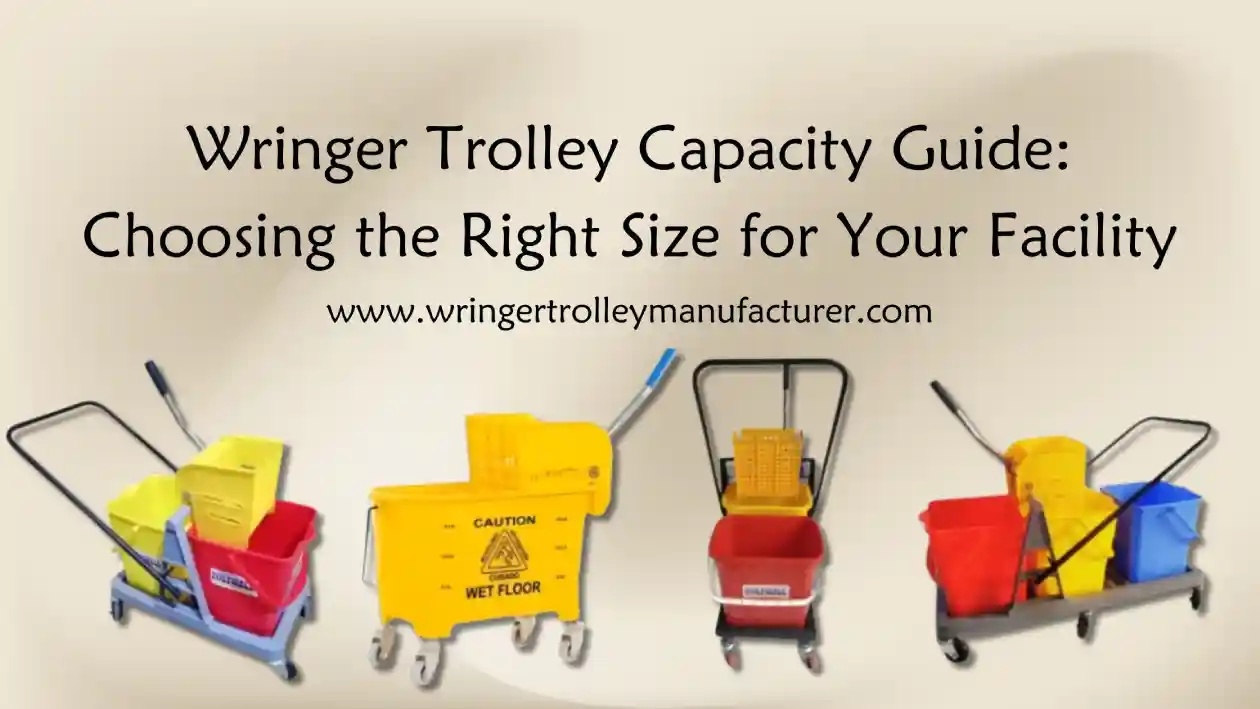
A single bucket wringer trolley has one primary compartment and can be suitable for straightforward mopping operations. It may be a practical choice for smaller facilities or cleaning routines that require a simple setup.
A double bucket wringer trolley provides two separate compartments and can be useful when cleaning procedures require different water sections. It may be particularly helpful in larger commercial or institutional cleaning operations.
The decision should be based on the cleaning method, facility requirements, and employee workflow rather than capacity alone.
Capacity and Employee Convenience
One of the most overlooked factors when choosing a wringer trolley is the person who will actually use it.
A trolley carrying a large amount of water can become significantly heavier. Cleaning employees may need to move it through corridors, around corners, into elevators, and between different rooms.
For this reason, the ideal trolley should offer enough capacity without becoming difficult to manoeuvre.
Businesses should also ensure that employees follow proper operating procedures and do not exceed the recommended filling level.
Why Material and Build Quality Matter
Capacity is only one part of trolley performance. The product should also be manufactured using suitable materials and designed for regular commercial use.
Cleaning trolleys are exposed to water, cleaning solutions, repeated movement, frequent emptying, and regular handling. Good material quality can contribute to durability and long-term usability.
Plastic is widely used in cleaning equipment because it can provide a useful combination of manageable weight, durability, and ease of maintenance when properly manufactured.
When comparing products, businesses should therefore evaluate the overall construction rather than choosing solely on the basis of capacity or price.
Choosing the Right Wringer Trolley Manufacturer
The manufacturer is an important part of the purchasing decision, particularly when an organization needs multiple units.
An experienced Wringer Trolley Manufacturer should understand the requirements of commercial and institutional cleaning operations. Product design, material selection, manufacturing consistency, quality control, and supply capabilities should all be considered.
For facility management companies, hotels, hospitals, cleaning contractors, and other large organizations, consistent product specifications can make procurement and daily operations easier.
Working directly with a manufacturer can also be useful when businesses require multiple units for different locations or departments.
Why Choose Sangam Plastic Industries Private Limited?
Sangam Plastic Industries Private Limited manufactures plastic products for cleaning, waste management, commercial, and institutional applications.
The company focuses on practical product design, suitable material selection, durability, and consistent manufacturing. Its products are intended to support the everyday requirements of businesses and institutions involved in cleaning and waste management.
For organizations evaluating wringer trolleys, factors such as capacity, dimensions, mobility, material quality, wringer design, and intended application should be considered before selecting a product.
Choosing an experienced manufacturer can help businesses procure cleaning equipment that aligns with their operational requirements and supports consistent use across different facilities.
Common Mistakes When Choosing Trolley Capacity
Businesses can make several mistakes when selecting a wringer trolley. Choosing the largest model simply because it offers greater capacity can result in unnecessary weight and reduced manoeuvrability.
On the other hand, selecting a very small trolley without considering the cleaning route may lead to frequent refilling and wasted employee time.
Other factors such as storage space, wheel performance, facility layout, cleaning frequency, and employee handling should also be considered.
A better approach is to evaluate the complete cleaning operation and then select the capacity that provides the right balance between water storage and mobility.
Conclusion
Choosing the right wringer trolley capacity can help commercial and institutional facilities make their cleaning operations more organized and efficient. The ideal size depends on the cleaning area, frequency of cleaning, distance to water sources, storage space, number of employees, and facility layout.
Small-capacity trolleys can be useful for compact spaces, while medium-capacity models offer a practical balance for many commercial applications. Larger-capacity trolleys may be better suited to extensive facilities with long cleaning routes.
However, capacity should never be considered on its own. Material quality, manoeuvrability, wheel performance, wringer design, durability, and ease of maintenance are equally important.
Working with a reliable Wringer Trolley Manufacturer can help businesses obtain consistent and practical cleaning equipment for regular commercial use.
Sangam Plastic Industries Private Limited provides plastic cleaning and waste management products for commercial and institutional requirements, with a focus on practical design, suitable materials, durability, and consistent manufacturing.
By assessing actual cleaning requirements before purchasing, facility managers can select a wringer trolley that provides the right combination of capacity, mobility, convenience, and long-term usability.